















This page is totally under construction!
An engineering design report is written to introduce and document an engineering design project. Audiences include other engineers interested in the design and management interested in how the design can be applied and commercialized. For example:
- Engineering students, for example, have written about the design of a temperature measurement and display system using a microcontroller and the design of a device to simulate flow through a ribbed cooling passage.
- Engineering students at Carnegie Mellon have designed a thermal-release ice maker.
Engineering Design Report: Thermal-Release Ice Maker (Carnegie Mellon University)
The design report has many of the same parts as the engineering report presented elsewhere in this book. The key differences are of course the purpose of the design report and special sections that are peculiar to this type of report. You can get an immediate sense of those sections by looking at which shows the table of contents of the thermal-release ice maker. shows pages from the body of the report.
Engineering Design Report: Design of a Small‐Scale Wind Turbine (Penn State University)
|
Executive Summary: Design of a Small‐Scale Wind Turbine to Improve Drinking Water in Garacad, Somalia Khalifa Alsuwaidi, Austin Kiker, and Robert Napoli Team 6.4, ME 340, Mechanical Engineering Department, Pennsylvania State University This document presents the design States the purpose of this engineering design report of a small-scale wind turbine
to improve drinking water in Garacad, Somalia. Access to safe water is a problem that 40% of the 783 million people living in Sub-Saharan Africa face every day [1]. More specifically, the population in Somalia has the lowest accessibility to clean water Some background on the problem the project addresses of any recognized country in the world. With a population of over 9 million people, 70% are drinking dirty water [2]. Because of the Somalis' lack of access to clean water, outbreaks of waterborne diseases such as Acute Watery Diarrhea (AWD), polio, and cholera are common [3]. In order to help improve the quality of drinking water in Garacad, our team has designed a small-scale wind turbine Provides a brief introductory description of the project result that can power a UV-LED light for water purification. The UV-LED, shown in Figure 1, is able to be powered by our wind turbine and can run on just 1 watt of power while destroying Briefly explains the benefits of the project 99.99% of harmful microorganisms in the water [4]. By using a UV-LED that is wind powered, the people living in Garacad would be able to drink water that is much cleaner.
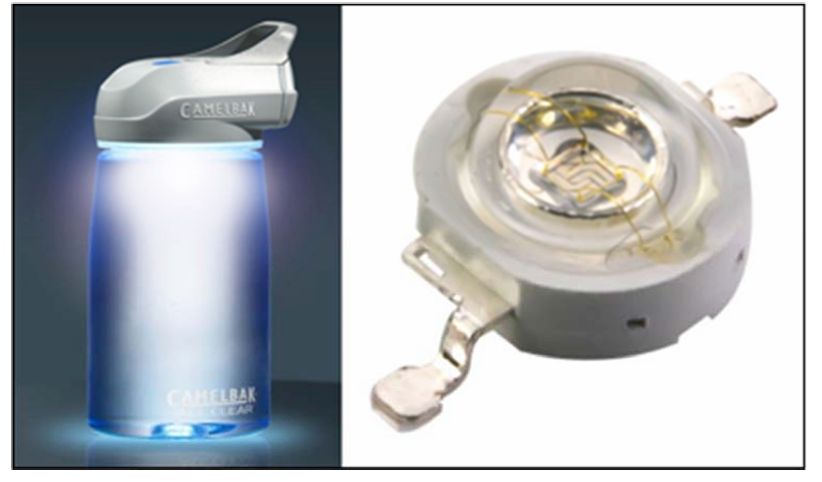
Figure 1. Water container that uses a UV-LED light attached to the inside of the lid [5,6]. The UV-LED light takes just 60 seconds to disinfect a container of water. The prototype needsStates requirements od the project for our small-scale wind turbine include power, durability,
aesthetics, and ease of manufacturing. The need for power was the primary goal that needed to
be satisfied by our wind turbine, because without power we cannot run the UV-LED light. Our
turbine also had to be durable to withstand high wind speeds, aesthetically pleasing, and able to be easily manufactured so that Somalians can fix their turbines in the event of external damage. Along with our customer needs were the accompanying metrics: withstand wind speed, time to manufacture, power generated, and cost. Each of these metrics were able to be related to at least one customer need which allowed us to see the interrelationships between the various customer needs.
The following sections Provides a list of sections contained in this report of the summary include concept generation, screening, and
selection, sequence of prototypes, and performance of our final design. These sections will
explain how we came up with our concepts, the process we took through each prototype, and
how our final design performed in the beta testing.
|
As you can see, this first paragraph of the engineering design report is quite long. Despite its length, it contains critical elements of an introduction: run your mouse over the dotted-line areas).
- The first highlighted area states the purpose of the document—a critical element that must occur or very neat the beginning the introduction. It also indicates the purpose of the project
- The second highlighted area provides background on the need for the the project. This provides omotivation to keep reading!
- The third highlighted area (and the rest of that first paragraph) briefly describes the result of the project—how the project will address the problem discussed in the preceding.
- The paragraph just after the graphic provides an overview of what the engineering students will need to carry out the project.
- The final paragraph of this introduction provides a roadmap as to what is ahad, the specific sections to follow in this engineering design report.
You might consider this sequence a recipe for your engineering design report:
purpose (document, project) → background: the need → brief project description → project result → project rqguirements→ list of report sections
For more detail on writing introductions for techdocs, see Online Technical Writing Textbook: Introductios.
Body of the design report
Aggravating Minutiae
What follows here is a list of stylistic issues that may seem way beneath your level of engineering brilliance. Luck for us we now have a intelligence to flag and correct these. Or, if you prefer humans, homo sapien copy editors are available: David McMurrey at admin@mcmassociates.io comes mind.
metric: British, American, Internation, or some combination?
numbers: digits or words? 4 volts dammit
this
Abbreviations, acronyms: m or meter? Write out unfam acronyms?
caps
Italics, bold?
Appendixes
Appendixes are those extra sections following the conclusion. What do you put in appendixes? Anything that does not comfortably fit in the main part of the report but cannot be left out of the report altogether. The appendix is commonly used for the following:
- Large tables of data
- Big chunks of sample code
- Fold-out maps
- Background too basic or too advanced for the body of the report
- Large illustrations that do not fit in the body of the report.
In other words, anything too large for the body of the report or too distracting and interruptive to the flow of the report is a good candidate for an appendix.
Documentation
Documentation is the system by which you indicate the sources of the information you borrow in order to write a report. Many engineers use the system created by the Institute of Electrical and Electronics Engineers (IEEE), examples of which are shown in the figures throughout this chapter and guidelines for which are shown in . As you'll see, this book espouses a simplified version of the IEEE documentation system.
Related Information
Reading quiz. Use this quiz to test your understanding of this chapter.
Training available. Get some practice writing with McMurrey as your instructor.
Sample Design Report.Penn State
Design Reports. Michael Alley, Penn State
Design of a Small‐Scale Wind Turbine to Improve Drinking Water in Garacad, Somalia. Penn State
I would appreciate your thoughts, reactions, criticism regarding this chapter: your response—David McMurrey.
