















This page is totally under construction!
A primary research report presents findings and interpretation from laboratory or field research. You can think of it as a lab report, but it's much more than that.
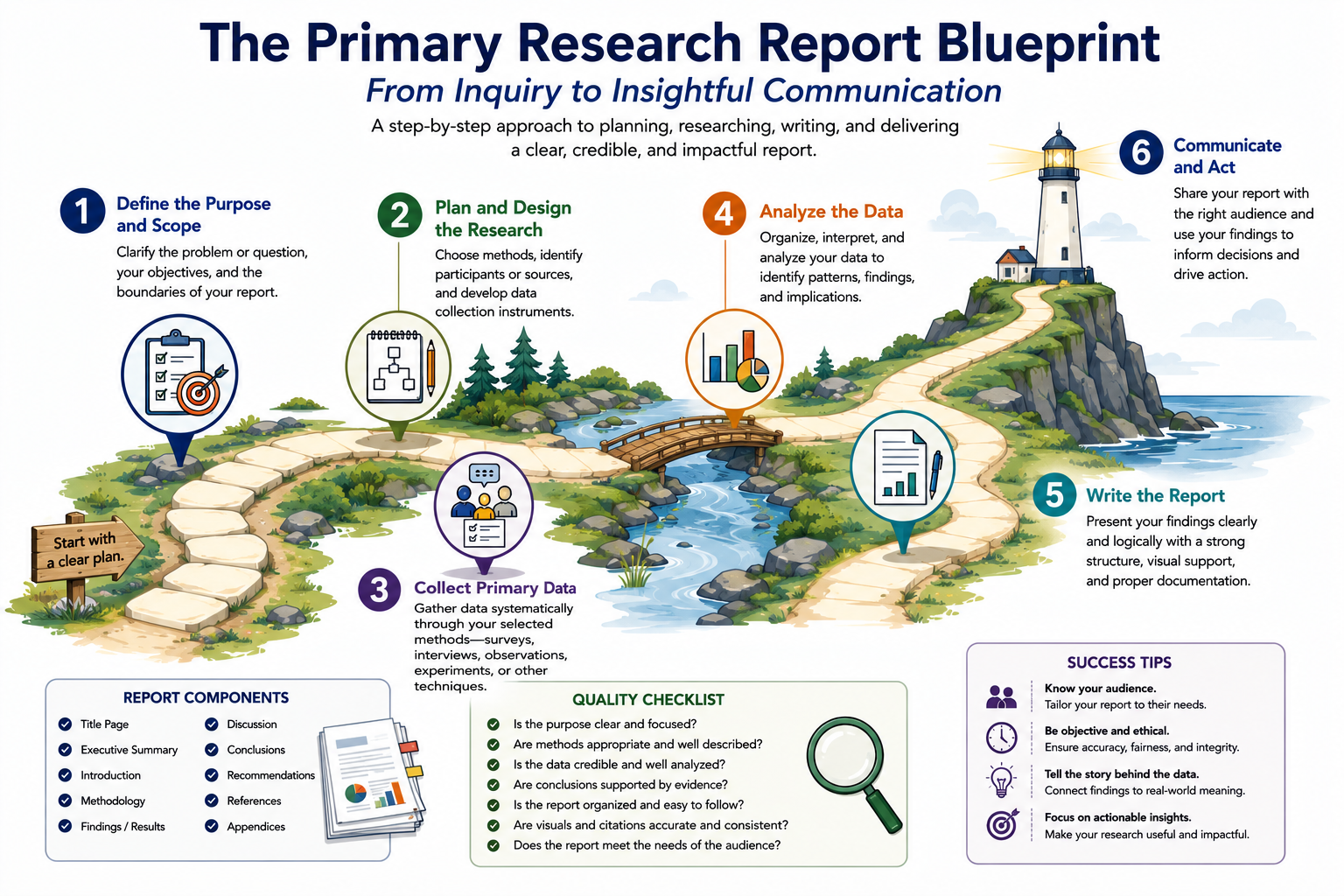 NotebookLM-generated infographic of this chapter
Top of the report
The top of a primary research report includes whatever the publishing journal requires. Here you see the name of the journal, then the report title, then the authors, then publication date:
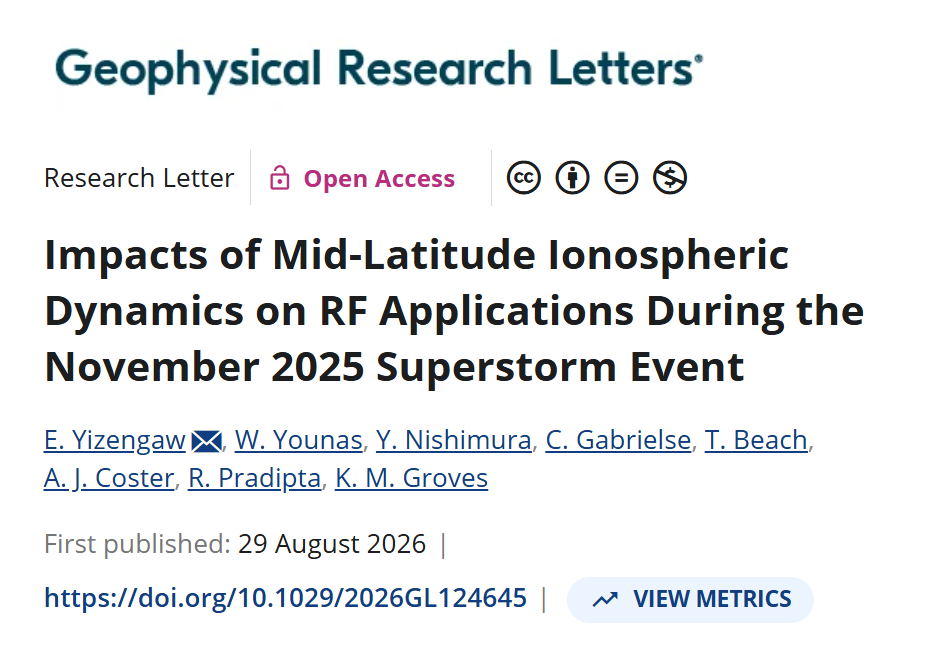
You read about the DOI at DOI Foundation
To enable readers to replicate your experiment or survey, you provide information like the following (each normally in its own section):
Although the sections and the titles of those sections vary, primary research reports have these typical contents:
Abstract
Below the primary research report title and authors, the abstract typically occurs:
|
Abstract This study demonstrates the intriguing and complex interplay among auroral precipitation, enhanced TEC, density irregularities, and amplitude scintillations observed during the November 2025 superstorm. For the first time, we present observations of strong amplitude scintillation across continental United States (CONUS)—nearly from coast to coast—caused by small-scale irregularities distributed over mid-latitude regions, impacting GNSS applications for hours. While mid-latitude phase scintillation associated with the storm-time equatorward expansion of the auroral oval occurs frequently, strong mid-latitude amplitude scintillation spanning a wide range of longitudes has never been reported before. During the storm main phase, an east–west elongated band of intense auroral brightness expanded equatorward and produced a horizontally extended strip of strong density gradients. These conditions favored the development of small-scale irregularities and consequently triggered pronounced amplitude scintillations (S4 > 0.5) and caused significant positioning errors exceeding 10 m—large enough to disrupt precision agriculture and autonomous transportation industries across CONUS. |
Plain language summary
An interesting structural addition to the primary research report is the plain-language summary occuring in at least one example just after the abstract. (See E. Yizengaw, et al. "Impacts of Mid-Latitude Ionospheric Dynamics on RF Applications During the November 2025 Superstorm Event", for an example).
|
Plain language summary A severe geomagnetic storm on 11 November 2025, brought the potential for auroral displays to be visible much further south in the continental U.S., reaching as far as central Florida. The storm also created complex and strong density irregularities in the ionosphere that can induce scintillations in radio frequency (RF) propagation, ultimately causing significant positioning errors. This study established a connection between auroral brightness and its impacts on technological systems, revealing that horizontal positioning errors exceeding 10 m—an error magnitude sufficient to disrupt farming and autonomous transportation—occurred in mid-latitude regions, an area typically considered relatively calm. This pronounced space weather impact was linked to an equatorward migration of the auroral oval, which produced a horizontally extended band of intense density gradients. These gradients favored the development of small-scale irregularities, triggering pronounced scintillations in RF propagation and significant positioning errors at mid-latitudes. The results underscore the importance of accurate understanding of various space weather phenomena to enhance our predictive capabilities through coordinated observations and physics-based modeling and ultimately reducing disruptions to RF applications during space weather events. |
Introduction
The introduction to the primary research report needs to do what any good introduction to a report needs to do—get readers ready to read the report. It may provide some background, but not more than a paragraph. Common elements, such as background, can be handled in the introduction. If they require a lot of discussion, however, they may need their own sections. For details, see the full discussion of introductions.
Here's a simple, straightforward introduction. Notice that the purposee of the resercch is not overtly stated (to compare breeding at diffrent creek temperatures), perhaps because it is obvious:
| The following reports on a study designed to compare spawning time and egg quality of rainbow trout broodstock maintained in cold creek water with those of broodstock maintained in constant temperature spring water. Included is a discussion of the research background, the methods and facilities used in the present study, and the results and conclusions drawn from the experiment. |
| One of the examples is an experiment to see whether production of rainbow trout can be increased by varying water temperature. While there is not a one-to-one correspondence between the typical sections in primary research reports and the sections you see in the actual rainbow trout report, you'll find that most of the functions are carried out. Instead of a full paragraph, sometimes all that is needed is a single sentence. And sometimes certain functions are combined into a single sentence. |  |
Here here are excerpt for much more ambitous research on geomagnetic storms. (For the full text, see E. Yizengaw, et al.)
| The occurrence of these irregularities [ionospheric density in geomagnetic storms] and hence scintillation is challenging to predict and model due to the many influencing factors, such as solar activity, interplanetary magnetic field variations, local electric fields and conductivity, convective processes, and wave interactions (Kintner et al., 2007; Tsunoda, 1988). Moreover, [ionospheric density irregularities vary according to geography except for those in the mid-latitude ionosphere which are generally more stable] ...
Consequently, a comprehensive understanding of the characteristics and impacts of ionospheric scintillation is essential to address both scientific questions and engineering challenges...
While mid-latitude phase scintillation associated with the storm-time equatorward expansion of the auroral oval occurs frequently, strong mid-latitude amplitude scintillation spanning a wide range of longitudes has never been reported before. Very limited observations—primarily at single locations—of mid-latitude amplitude scintillation have been reported (e.g., Ledvina et al., 2002; Spogli et al., 2009; Jean et al., 2017; Rodrigues et al., 2021). In this paper, we present a multi-instrument observational analysis of mid-latitude ionospheric dynamics during the 11 November 2025 super storm. For the first time, we present observations of amplitude scintillation across CONUS—nearly from the East Coast to the West Coast—caused by Fresnel-scale irregularities distributed over mid-latitude regions...which for hours, [disrupted] particularly precision agriculture and autonomous transportation industries. |
Literature review (problem, background)
One of the first things to do is to discuss the situation that has led to the research work. This segment of the primary research report is called the literature review but may also be called background or problem. It can be a sentence or two in the introduction or a section of its own.
Construct the literature review in such a way that it shows the sequence of past research in relation to your current research. Does your research prove, disprove, or simply add to what is alreasy known? See the examples in literature review.
Purpose, objectives, scope
Also toward the beginning of this type of report discuss what you intended to do in the research project—what were your objectives? Also, explain the scope of your work—what were you not trying to do?
Materials, equipment, facilities
Remember that one of your goals in writing this type of report is to enable the reader to replicate the experiment or survey you performed. Key to this is the discussion of the equipment and facilities you used in your research. Describe things in detail, providing brand names, model numbers, sizes, and other such specifications.
Theory, methods, procedures
To enable readers to replicate your project, you must also explain the procedures or methods you used. This discussion can be step by step: "first, I did this, then I did that...." Theory and method refer more to the intellectual or conceptual framework of your project. These explain why you used the procedures that you used.
Results, findings, data
Critical to any primary research report is the data that you collect. You present it in tables, charts, and graphs (see the chapter on creating, formatting, and incorporating graphics into your reports). These can go in the body of your report, or in appendixes if they are so big that they interrupt the flow of your discussion. Of course, some results or findings may not be presentable as tables, charts, or graphs. In these cases, you just discuss it in paragraphs. In any case, you do not add interpretation to this presentation of data. You merely present the data, without trying to explain it.
For very bsic research, you will see "Observations" as the heading indicating
Discussion, conclusions, recommendations
In primary research reports, you interpret or discuss your findings in a section separate from the one where you present the data. Now's the time to explain your data, to interpret it. This section, or area of the report, is also the place to make recommendations or state ideas for further research.
Bibliography
The ideal of the primary research report is build upon or add to the knowledge in a particular area. It's the vehicle by which our knowledge advances for a specific topic. Your primary research report rests on top of all the work done by other researchers on the same topic. For that reason, you must list the sources of information you used or consulted in your project. This list occurs at the end of the report. For guidelines and format, see the chapter on documentation.
Typical format and organization of primary research reports
In most technical-writing courses, you should use a format like the one shown in the chapter on report format. (The format you see in the example starting on page is for journal articles). In a primary research report for a technical-writing course, however, you should probably use the format in which you have a transmittal latter, title page, table of contents, list of figures, and abstracts and in which you bind the report.
As for the organization of a primary research report, the typical contents just listed are arranged in an actual primary research report in just about the same order they were just discussed. Loosely, it is a chronological order. First, you discuss set-up issues such as the problem and objectives, then you discuss the procedures, then the data resulting from those procedures, then your conclusions based upon that data.
Figures, tables, explanatory cross-references
You can see, but probably not comprehend, the charts or their explanations here. But explanation of what's going on the charts, figures, and tables is critical. The six (a–g) parenthetical letters in the cross-reference below the charts explain to spcialists in that field what is signigicant.
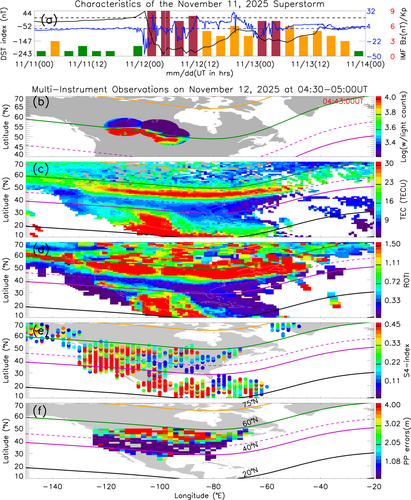 Shows 2D (longitude vs. latitude) maps of different parameters: (a) displays storm-characterizing indices as a function of time, including the Dst index (black curve), IMF Bz (blue curve), and the Kp index (colored bars—and its scale is shown in red on the right axis), (b) auroral brightness, (c) ground-based GNSS vTEC, (d) ground-based ROTI, (e) S4 index from L1 frequency, and (f) positioning errors.
|
Here's a much simpler example:
Related information
Example of a well-written lab report. Reed College
Writing the Experimental Report: Overview, Introductions, and Literature Reviews. Purdue OWL
E. Yizengaw, et al. "Impacts of Mid-Latitude Ionospheric Dynamics on RF Applications During the November 2025 Superstorm Event", Gophysical research Letters, Aug. 29, 2026.
I would appreciate your thoughts, reactions, criticism regarding this chapter: your response—David McMurrey.
